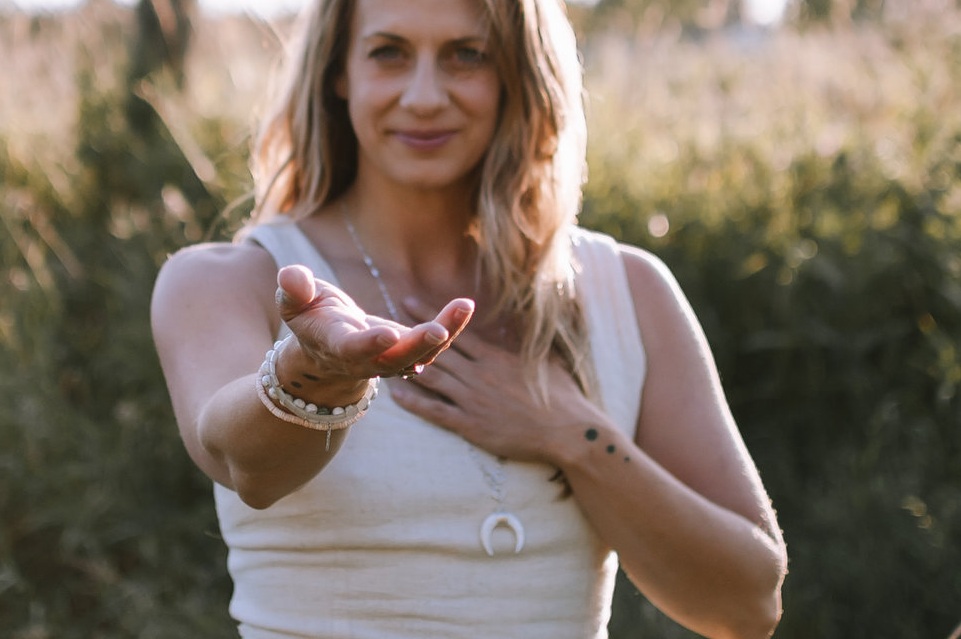
About Me
I left my career of 10 years in a stable advertising agency to…teach yoga. It could be the best thing I’ve ever done, but definitely not the easiest. Some people (myself included) considered it a risky move – something out of the ordinary.
I wanted to follow my heart.
I was so ready that my days at the office were filled with demonstrating how to heal injuries instead of checking unread emails. The burning desire to step away from my desk and into a yoga pose known as “Warrior” became too strong to ignore. It turns out I needed the warrior persona on my journey to follow my dreams.
The challenges are tangible but I’m proud to say that each one is 100% worth the experience of following my heart. I survive in this city no longer by having a job, but instead, by sharing my passion.
When you love what you do, it shows.
What You'll Get in a Class
While my classes are Hatha based, they're graced with Anusara elements. You'll discover the healing Universal Principles of Alignment to ensure your safety and stability in all poses.
I teach a heart-opening, soulful class that will open your body and your mind. You can expect to be challenged, while put at ease. Classes are a mix of stress relieving poses and poses that require presence. You’ll be sweating with a smile.
My Stats
I have over 550 hours of teacher training, combining Hatha, Power & Anusara methods, as well as 1000+ hours of deep study with teachers such as Noah Maze, Desiree Rumbaugh, Elena Brower, Chris Chavez, Christi-an Slomka, Robin Golt, Darren Rhodes John Friend, and Kino. I've also studied therapeutic yoga with Martin Kirk and love to share it’s healing qualities for any and all injuries.
Rock Om!
Why yoga at your office? It offers tools to help deal with work related stress.
In 2010, 27% of working adults, (3.7 million people!), described their lives as stressful. Another 46% (6.3 million!) said they were 'a bit' stressed. 62% identified work as the main source of their stress.[1] And guess what? Work-related stress has a direct connection to the productivity of workers re: reduced work activities, disability days and absenteeism -not to mention lower levels of health. [2]
I know the demands of the workplace can be intense, but I also know yoga can help offer balance to those demands. It helps to reduce stress, enhance awareness and boost health while strengthening the body. Having spent 10+ years in a corporate environment, and over 8 years studying yoga, I understand how to seamlessly marry these two facets of life.
To all employers thinking of offering yoga: Give your employees a yoga oasis hour and enjoy payback thru increased employee health, increased productivity and more smiles.
To all employees wishing your office had yoga: Ask for it! Learn how to release stress, reduce headaches, boost your health and in turn, smile more.
Investment Options:
Contact me for details – I’d love to help.
*TBD on travel time to your workplace.
Whether you feel like deepening your practice or simply beginning one, private yoga classes offer you a chance to discover a practice tailored specifically to your needs. Once you come to the mat, yoga's healing qualities will sneak into your life, even off the mat. It's known to reduce stress, enhance awareness, and boost health while it strengthens the body. It also helps to heal any injuries and is highly therapeutic.
With my Yoga for You program you’ll receive personal alignment instructions and therapeutic exercises specific for your body type. Learn how to speed up the healing of any and all injuries and take away a practice you can work with between sessions.
Yoga for You can take place in the comfort of your home, in your hotel room, or another location worked out together. It could even include some of your friends.
Investment:
Single private class: $85 *
Package of 5 private sessions: $400 (save $5 per class). *
Package of 10 private sessions: $750 (save $10 per class). *
*TBD based on travel time to your house.I look forward to hearing from you!
What is Reiki?

Reiki is a Japanese holistic, energy-based healing technique. Working as support to the body, Reiki re-establishes a healthy energy flow throughout the physical and energetic system, which in turn can enhance the body's natural healing ability. Reiki supports any medical or supplemental healing method.
Our energetic body is directly connected to the quality of health we experience. Dis-ease always begins in our energy field so when we keep our energy body healthy using Reiki, and our physical body healthy with good nutrition and exercise, we're able to remain at our best.
What Can Reiki Do?
Reiki is a technique of healing, stress reduction and relaxation that taps into this 'life force' energy. Reiki improves our health and enhances the quality of life we experience. You may experience some of the following benefits:
What Happens During a Session?
The treatment is simple, natural and safe. The client is usually lying down and remains fully clothed. The practitioner places her hands on or near the client's body in a series of hand positions. These include positions around the head and shoulders, stomach and feet. Reiki energy flows from the practitioners hands into the client.
How Long is a Treatment?
Treatments usually range from 60 minutes to 90 minutes.
My Background With Reiki
I was first attuned to Reiki levels 1 & 2 when I was 18. Now, at 32, I've been attuned to the Reiki Master degree in both the Usui system and the Seichim systems of healing. I've seen it work and felt it for myself - it's a wonderful healing complement to any lifestyle.
Sometimes I receive intuitive information while giving Reiki in regards to your health state and/or your emotional state. This information usually comes in way of suggesting what you can do to feel better - I will always offer to share that with you after your session.
How Many Sessions Do You Need?
To begin with, three or four sessions over ten to fourteen days are recommended to remove entrenched blocks in your energy system. Following that, once a week or once every two weeks until the issue has resolved. You will begin to notice some improvement after the first session. Long-standing health issues are usually cleared up in five to six visits.
Investment:
First treatment:
60 minute treatment: $85
90 minute treatment: $105
Following treatments:
60 minute treatment: $75
90 minute treatment: $90
Questions?
Please ask!
"Every day I think about the beautiful impact that you have made on my life and the lives of all those you touch. Thank you from the bottom of my heart for your loving instruction of the Reiki course and your gentleness with my dear daughter Alison. You have given me a great gift and set me on a path of love and kindness. What great teachers you are. You are both so very dear."
- Mary Anne Chown
Background: I’ve been practicing yoga for 10+ years, but more seriously in the past 5. I had what I would call a fairly advanced practice; Urdhva Dhanurasana is no problem, headstand without a wall is all good, drop backs are a bit scary but totally do-able. I don’t practice in the heat - ever. I did a full yoga class 3x per week and scattered yoga poses through out my day - until my 1 month Ashtanga challenge.
Here’s a real time account of my personal Ashtanga challenge at AYCT.
Day 1: Kinda nervous. Practice is shorter than I expected as I’m only given up to Parsvottanasana so I can memorize the sequence.
It’s hotter than I thought and the room’s smell reflects it.
Day 2: The heat! I learn I’m not allowed to bring my water into the room with me. “This is going to kill me” is what goes through my head. I start a habit of drinking half the bottle before my practice and leaving it at the back of the room for when I’m finished. Up to Pascimottasana.
Day 3: Barely making it through. Struggling with the heat, and the idea that I may dehydrate… or die.
Day 4: Fighting panic attacks in the room due to the heat - no one knows but me. The thought that I may die crosses my mind too many times; my mouth is dry, I’m sweating a ton and it’s hot - it’s so hot. I have to look at the older people in the room for inspiration (and to convince myself that I won’t die).
Day 5: Still fighting panic attacks in the room. They’re all in my head. Why are people cross eyed?!
Day 6: I can’t stand the sweat that runs into my eyes - new (least) favourite focus, other than watching the weird assists.
Day 7: I bring a towel into the room to wipe the sweat from my eyes- new favourite past time during practice.
Week 2: Teacher tells me to stop wiping my face so much and focus more. Still fighting panic attacks from the thought that I may die from dehydration or heat stroke. Once I’m out of the room and practice is over, I realize I’m being completely dramatic.
I’m ridiculously tired and nap at least 3x during the week. Sore. So. Sore. Left knee seems tweaked.
People actually get sat on in the practice room. I dread that assist!
Week 3: Up to Janu Sirsasana C. Still sore and still napping after practice. My left wrist is showing signs of injury. I no longer consider my practice advanced. This style is schooling me!
Can’t get the smell out of my clothing. Having to soak clothes, then wash them. They don’t even smell like me - they smell like the room!
Week 4: Almost done my 1 month challenge. Up to Bujapidasana, then to Urdhva Dhanurasana with drop backs on my own. Getting schooled on keeping my heels down in drop backs. I can’t do it - it’s uncomfortable in my low back and I just don’t understand the muscles required to keep my heels down yet.
Left knee is better. I’m noticing major changes in my practice; I’m much stronger and dare I say, the practice may be getting easier? Left wrist is better, right wrist is sore.
I tried to press up to handstand (not kick up) at home against a wall - my feet lifted off and I freaked out from the feeling. Fell out of it, and ran to jump on the bed. I’ll try again in a few weeks.
Loving the forward fold assists daily and working on my own cross-eyes. Drishti baby.
Week 5: Given Supta Kourmasana assisted. Jesus - how does one breathe in that pose?!
Forgot to drink half my water before practice and still survived.
Marichiasana D needs an assist on both sides in order to bind.
Can’t stop now. One month challenge is extended until…? Plus I’m head over heels for the studio mascot, Bambi.
Week 6: Up to Garba Pindasana. Can’t even get my finger tips through my legs - no matter the amount of lubrication. The rolling around part feels so ridiculous.
Able to place focus on things like keeping my foot arches lifted - no longer just barely making it through. Panic attacks are gone. Not even bringing my water to the back of the room anymore.
Week 7 beginning: Hands are through in Garba Pindasana! Boom! But now I’m tipping when I try to roll around. So frustrating! I have a love/hate relationship with the practice.
Week 7 end: Forearms through in Garba Pindasana! Major bruises on my inner elbows however. Rolling around with more control, less tipping. Jump throughs are coming! The key is to reach my chest forward as I jump!
Complained to my teacher that I can’t get my arms through past my elbows in Garba Pindasana - he kindly reminded me that I was complaining not long ago about my fingertips not going through. The grass is always greener!
Week 8: Convinced my husband to try it out. He’s coming daily now too.
Tweaked my right knee in Garba Pindasana. Can no longer do 1/2 lotus with the right leg - need to let it heal and modify through the practice.
Week 9: Bruises on ankles from jump throughs are constant.
Week 10: Marichiasana D to the left without assist!
Week 13: Convinced that drinking 1/2 a coconut water before practice makes my practice better. Putting this to the test. Have my husband in on it too.
Ankle bruises seem to be diminishing.
Week 14: I’m light! Floating through better than ever. Catching air on the jump backs too. Have no idea how or why it’s happening yet. Just started happening one day!
First drop back with my heels down happens! Coming back up does not happen.
Right knee finally feels better. Back with Garba - forgot how much of a pain that pose is. Arms go through easily, but stuck at elbows. Back with the elbow bruises!
Month 4: Baddha Konasana a & b is given to me. Forgot to drink 1/2 coconut water before going into the practice room; thinking Mula Bandha is easier without a liquid filled belly.
Frustrated at coming up from drop backs without flinging myself into the person in front of me. Feeling annoyed at the lanky, overly flexible man next to me in practice. His legs are all up in my space.
Gave it a good go on coming up from drop backs. Must have let out a noise or loud breath because the lanky man offered a whisper of encouragement: “That’s good! You’ve almost got it”. I wanted to cry - I was previously thinking mean thoughts about him.
Month 4, week 2: Tweaked knee again. Back with modified Garba Pindasana. Tweaked right wrist, feeling sharp wrist pain in jump throughs and jump backs. Jump throughs and jump backs are on hold. Working on patience in full force - not going so well.
Month 4, week 3: Back with Garba Pindasana. Tweaked left shoulder when compensating for my right wrist. Back is hurting in drop backs - I seem to have a vertebrae that’s pushing inwards. Drop backs are assisted again. Feeling pretty low about my practice with all the modifications these days.
Month 5: Up to Urdhva Mukha Pacimottanasana. Hard pose - what on earth am I supposed to balance on?? One pose left until I complete the Primary Series (Setu Bandhasana)!
Month 5.5: Back is starting to feel better although I can still feel 1 vertebrae pushing in. Discovered that keeping my first finger, middle knuckle down supports my wrist. Building forearm strength to really keep it down now.
Loving the dedication and devotion that the practice brings to my life. I feel more settled after my practice is complete in the mornings. I do miss other poses from other styles (pigeon, side plank, wild thing, Hanumanasana (splits), handstand to name a few) so I’m trying to do one other class per week to keep this side of me happy. I’m also doing some of these poses at home on my own.
I love the community at the Shala and I love my teacher David Robson! Super glad I started this personal challenge in the first place.
1. Check out different teachers and different classes regularly.
Different teachers will offer you different flows, different poses and different alignment cues. If you’re open to it, you’ll always pick up something new you can use. If you find a teacher/style that challenges you like no other, stick with them for awhile until that changes again. Then repeat this step.
2. Time your poses.
Interval style. Try 1 minute holds, then up it to 2 minutes. It’s one thing to make it into a pose but completely different to hold that pose. Try it out!
3. Break routine or find routine.
If you don’t have a routine, starting one can deepen your practice. Try doing the same poses daily for a month and watch the progression! If you already have a routine, adding poses to practice will give your body something new to work with. Change up your patterns as well such as what side you do first, what leg you kick into handstand with, and what leg you put into lotus (or a cross legged seat) first.
4. Find your edge.
…and play it. Your edge is a place of fear, possibility and breakthrough’s. The best yogi’s know how to fall, and how to get back up.
5. Listen.
You of all people know exactly what you can do to deepen your practice. Just listen to your body and your mind. It’s likely the things that scare you a little, are the things you need more of. Listen to your inner guide and step into your own light.
“But what if this? What if you are meant
to feel the world inhospitable, unfriendly, off-track
in just the particular ways that you do?”
.
“The world has a you-shaped hole in it.
It is missing what you see.
It lacks what you know.”
.
“And so you were called into being.
To see the gap, to feel the pain of it, and to fill it.”
.
“Fillling it is speaking what is missing.
Filling it is stepping into the center of the crowd,
into a clearing, and stating,
here, my friends, is the future.
Filling it is being what is missing, becoming it.”
.
“You don’t have to do it all, but you do have to speak it.
You have to tell your slice of the truth.
You do have to walk toward it with your choices,
with your own being.”
.
“Then allies and energies will come to you like fireflies swirling around a light.”
.
“The roughness of the world, the off-track-ness,
the folly that you see,
these are the most precious gifts
you will receive in this lifetime.”
.
“They are not here to distance you from the world,
but to guide you, into your contribution to it.”
.
“The world was made with a you-shaped hole in it.
In that way you are important.
In that way you are here to make the world.
In that way you are called.”
I’ve avoided making new year resolutions for a few years. That’s right - avoided.
I was afraid to fail.
According to the University of Scranton’s Journal of Clinical Psychology, I’m not the only one. Their study reveals that 45% of us make New Year’s resolutions, but only 8% keep them.
I refuse to be in the 8%.
I’ve been working with an amazing life coach for 2 years now and keeping promises is no longer a problem - however, it’s still a challenge. Below are 5 steps that help me keep my new year resolutions:
#1: Write them down.
In the process of writing your intentions, you’ll become really clear on what they are. Sometimes we have an idea but until it’s formulated in words, that idea isn’t clear enough to follow through on. We need clear instruction and clear intention to commit to.
You’ll also be devoting the first amount of time to your resolutions as you write them. This alone is building your dedication to keep them.
#2: Define what they look and feel like.
This is huge. Take your intention and expand on it by defining how it changes your life. For example, if your intention is to work out more, organize your calendar so you know exactly what and when “more” is. If your intention is to listen clearly to others, when they’re done speaking repeat back to them. It could be as simple as “so you’re feeling like [insert what you heard here].”
Then write out how it’ll feel to keep your resolutions: “I feel more confident and healthy” or “I feel more sensitive to others needs and my relationships are deepening.” In writing out how it feels to have these new resolutions as part of your life, you’ll discover the why you want to keep them in the first place!
#3: Make a routine out of it.
Routine is grounding and easier to keep than sporadic thoughts of “I should be doing _______.”
If your resolutions don’t seem like something you can make a physical routine out of, call yourself on bullshit (then thank yourself for such a good lame excuse). It’s totally possible, you may just need to be a little creative.
#4: Tell your family and friends.
Go public with your resolutions. Get people to call you on your excuses and help you keep your intentions. Otherwise, they may be helping you make excuses not to keep them. If you tell them sincerely, they’ll be more than happy to help you (really! who doesn’t love to help those you care about?!).
#5. Understand.
The practice of keeping your intentions is the same as keeping promises to yourself. It’s a practice of self respect. Self respect is spiritual.
It’s a practice that will ask the old you to step aside, and the new you to come in. Change may not be easy, but change is the essence of possibility.
Why go another day missing something that you really want to be doing?
Check out my post over at Halfmoon on how to use your bolster in arm balances. Real life yoga style.
I love this poster. I love this idea. It’s by far the healthiest thing you can do for yourself: Love Your Life.
1) Make a promise and keep it.
This practice alone may be harder than your actual yoga practice. If you can nail this, you’re setting yourself up for some serious self respect. Keep your word and you’ll learn to trust yourself. Be the kind of person who does what they say because hitting the snooze button isn’t worth the guilt of going back on your own word.
2) Make friends at the studio.
A lot of them. You’ll look forward to seeing them and they’ll notice if you’re not there. You’ll meet those who inspire you and those who you’ll inspire. You’re not alone in the practice.
3) Prepare the night before.
Go to bed early. Seems obvious right? Then do it. It prepares your mind to follow through on your promise the night before - no more early morning decisions. It makes a fantastic difference. Also set out everything you need for the morning at night.
4) Get up at the same time each day.
Your body loves rhythm. Bringing it back to a rhythm first thing in the morning will be grounding and relaxing. Even though you’re getting out of bed, this morning routine will relax you and make you feel more rested throughout the day.
5) Remember you want to do this.
It was your idea in the first place. Remind yourself of your love for the practice.
6) Deepen your inhale.
As you wake up, your inhale will naturally deepen - it’s the awakening part of your breath. Help yourself along and put some focus on deepening your early morning inhales more.
7) Stay warm.
In the winter months it’s hardest to get out of bed if the air outside your blanket is cold. Wear something warm to bed and remove some of the the shock of removing your blanket. Know that getting up and practicing will warm your core temperature for the day. Yes please!
8) Shake it out.
Shake out your sleepiness by… shaking. Or try dancing. But most definitely move immediately.
9) Understand the benefits.
Know that your yoga practice isn’t just physically beneficial. Your practice of waking up, keeping a promise and forming self respect by following through is priceless. But you already knew that - that’s why the mat is calling you.
10) Answer the call.
You’re called to this for a reason. Trust it.
…and build your bakasana!
Check out my blog post over at Halfmoon’s Yoga Blog!
I left my stressful job in advertising last October to teach yoga. I’m loving every second, but none of those seconds are made easy without me designing them that way.
You see, my programming from the 10+ years in the ad world stuck with me; I’m really good at moving fast and filling my time. What I’m not so good at however, is slowing down. I can push, sprint and jump (how high?!), but ask me to slow down and I’m either instantly annoyed or instantly challenged. Often both.
But I kept finding myself overwhelmed…by choice. My schedule was part of my daily design. I kept saying “yes” to everything that came my way from teachings gigs, writing articles, offering retreats - all things I figured would boost my new career. But I ran out of time. I couldn’t find time to do it all whole heartedly and that drove me nuts. I was conflicted and stressed. I ran out of personal time too - I couldn’t find time to meditate, to practice daily, to enjoy my dog and even my husband. I had no time to keep the promises I made to myself because I had made a new promise to someone else. I kept saying “yes” yet again.
So now, I’m saying “no” to at least one thing per day. It was my life coach’s idea (thanks Handel Group and Hildie Dunn). When she first suggested it, I laughed and thought “what on earth will I say no to?!” Sure enough, there was lots. This past week I was able to enjoy meals again, had dinner out with my husband, I finished reading a book and even went for 2 runs. I practiced yoga and held poses longer. I slowed the eff down and enjoyed myself.
In my new daily design, saying “no” is just as important as saying “yes.” I like to think of it this way: By saying no, I’m saying yes to myself. To my soul. To what I really need to be able to make the next “yes” whole hearted.
And let me tell you, whole hearted yes’s are the best kind out there.